
The Model for Advancing Public Safety® (MAPS®) is based on:
-
Industry standards developed by organizations and workgroups such as the Federal Communications Commission’s (FCC) Task Force on Optimal Public Safety Answering Point (PSAP) Architecture (TFOPA), the National Institute of Standards and Technology (NIST), the National Emergency Number Association (NENA), and the Association of Public‑Safety Communications Officials‑International (APCO)
-
Best practices
-
MCP’s collective expertise
How the MAPS Methodology Works
Since its inception, MCP has conducted hundreds of assessments of clients’ technologies, operations, staffing, funding, and governance. These assessments largely have been qualitative based on the experience and knowledge of the firm’s subject‑matter experts. Driven by a desire to introduce quantitative analysis into these assessments, MCP launched the MAPS methodology. The methodology — which is based on industry standards and best practices in addition to the firm’s collective expertise — enables officials to immediately discern and understand where their organizations stands regarding numerous factors.
Question Set
MAPS leverages a quantitative and qualitative question set, and the questions are weighted based on importance. For example, weighting for a technological assessment would consider how likely each factor would cause a system failure. For example, power, transport, and cybersecurity factors would be given greater weight than other factors.
Collaborative Interview
MCP uses the question set in collaborative interviews with an organization’s officials and stakeholders. Many questions are asked multiple times to uncover potential discrepancies in the provided answers. Follow‑up interviews address disparities and dive deeper into questions for which officials and stakeholders could not provide answers.
Scoring and Blueprints
A vital element of the MAPS offering is a color‑coded blueprint that illustrates the status of each factor that was assessed. The colors are easy to grasp: Green indicates factors that are at low risk and thus not in need of immediate attention (scores ranging from 7.1–10). Yellow indicates those at medium risk (scores ranging from 4.0–7.0). Red indicates factors that are at high risk (scores ranging from 0–3.9).
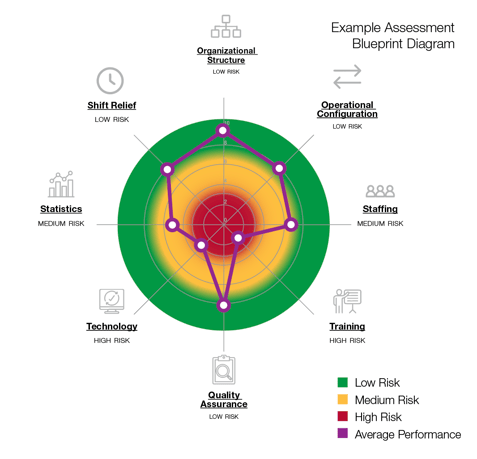
The MAPS scoring and blueprint become the basis of a comprehensive recommendations report that guides the organization regarding specific strategies for addressing the identified risk factors. The blueprint enables officials to determine where efforts and resources need to be placed to shore up areas of weakness.
The 2026 report includes data from assessments completed by MCP since August of 2022.